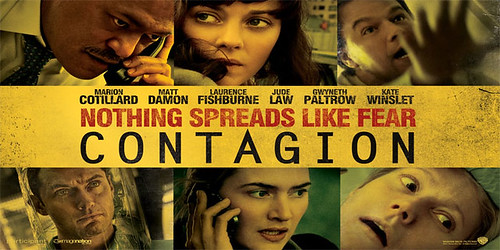
The movie starts on Day 2 with Beth Emhoff (Gwyneth Paltrow) talking on the phone. Her nose is slightly red and she has a cough. Nothing to worry about. She's on the phone with someone and it's soon clear that her recent rendezvous is not her husband. During her layover from a business trip in Hong Kong, she hooked up with an old flame.
 A montage of other people: a young man in Hong Kong, sweating. A model in London, who skips her go-see and is later found dead in her hotel. A Japanese businessman convulses and dies on a bus. It is captured with a camera phone. The young man in Hong Kong wanders out of his apartment, obviously sick, and stumbles out into the street where he is hit by a bus.
 We see Beth returning to Minneapolis to her husband, Mitch (Matt Damon) and their son, Clark (Griffin Kane).
Day 3.
We meet Dr. Ellis Cheever (Laurence Fishburne) who works at the CDC (Centers for Disease Control). Mitch picks up his son from school, who has started feeling sick. At a newspaper, a blogger named Alan Krumwiede (Jude Law) has a theory about the Tokyo bus incident: mercury poisoning in fish. He threatens the editor with a lawsuit if she steals his story.
Day 4.
 Beth collapses with a seizure and is rushed to the hospital. A doctor later tells Mitch that she is dead. Mitch struggles to understand what's happening, because no one knows why she died.
On Mitch's way home, his babysitter calls to tell him that Clark is sick. By the time Mitch arrives, Clark is dead, apparently of the same thing his mother had.
Day 5.
Dr. Leonora Orantes (Marion Cotillard) handles a briefing at the World Health Organization about an unknown virus and cases in the US, China, the UK and Japan. Beth is mentioned.
In Hong Kong, sister of the dead man dies on a bus before she can scatter his ashes. In Chicago, Beth's lover, John, is rushed to the hospital.
In Minneapolis, 2 coroners begin an autopsy of Beth, opening up her skull. There's something strange about her brain. While one coroner wonders about taking a sample, the other admonishes him to "stand away from the table!" and to call *everyone.*
 Day 6.
 Mitch is in quarantine, still uninfected. His daughter, Jory (Anna Jacoby-Heron) arrives. They talk via a phone and she refuses to leave.
Cheever briefs Dr. Erin Mears (Kate Winslet) before she leaves for Minnesota. Once there, she gives a briefing about the virus and the precautions needed, noting that this virus is passed through touch and its infection rate could be greater than the flu or polio.
Drs. Ally Hextall (Jennifer Ehle) and David Eisenberg (Demetri Martin) begin to work on samples taken from Beth and the others. Some of it is sent to Ian Sussman (Elliott Gould) at another facility. Sussman is accosted by Krumwiede, who suspects the virus is being manufactured as a profit-making scheme by drug companies.
 Day 7.
 Cheever meets with Lyle Haggerty (Bryan Cranston), a liason from Homeland Security. There is concern that the outbreak is caused by a terrorist attack.
The news reports that Clark's school has been closed after 3 nurses and 2 students die. Tension rises as panic begins to set in.
Mears travels to Beth's office. The only person who saw her after her return from China was Aaron Barnes. Mears immediately leaves to find him. Mears reaches him, via phone, while he is on a bus. Trying to sound calm, Mears orders him off the bus as soon as possible. When Barnes worries, she tries to calm him, but we (the audience) knows what's coming.
A doctor questions Mitch about Beth's Chicago layover and Mitch realizes Beth's infidelity. This weighs on him the rest of the film.
Hextall and Eisenberg brief Cheever on the virus, based on the sample taken from Beth's body. A body can defend itself, so the virus quickly multiplies. There are traces of bat and pig in the virus's genetic code.
 Day 8.
 Cheever briefs the CDC on the worldwide pandemic. The numbers of infected have reached over 80,000, with estimates as high as 267,000. Krumwiede blogs, claiming government collusion with drug companies for the sake of profit and that a cure is being suppressed by the CDC. Orantes travels to Hong Kong to trace the outbreak to its source. Her liaison, Sun Feng (Chini Han), assists her investigation. Orantes suspects that Beth is Patient Zero.
Day 12. Day 14. The movie goes on. More people die. Others fight to find the cure. The world devolves. Just as he did with Crash, Soderbergh paints a picture of the human condition, as they confront something extreme. Some of the people that we meet, people you want to survive, die. Others that you don't, live. The movie tells the story of how, in desperate times, the best and the worst of human nature arises. Desperate people riot, loot, and kidnap to try to survive. The blogger, Krumwiede, uses mis-information for his own ends. Doctors risk their lives to treat patients and to uncover a cure. Soldiers risk their lives to do their job even while risking infection. We follow Mitch as he tries to keep his daughter alive.
 While some reviews complain about how the film loses steam in the second half, and the multiple story threads distracted from the impact of things, I disagree. I walked out of the theater with the somber realization that this type of thing *could* happen.The fact that we don't follow one central protagonist, but our attentions instead are split between many people, makes the movie all the more harrowing and realistic. Events like these, that happen in the real world, are solved by many people, not some superhuman hero.
The New York Times reports that Soderbergh went to great lengths to make the film realistic, working closely with Dr. Ian Lipkin, Director of the Center for Infection and Immunity at Columbia University, Dr. Lipkin was responsible for the idea behind the film's virus, modeling it off of a rare Nipah virus which killed over 100 people and resulted in the extermination of over a million pigs in Malaysia in 1999. Lipkin spent weeks on the set and even had scenes reshot so that they would be scientifically accurate.
 I appreciate that accuracy. It's inherently why the movie is as scary as it is - it shows how in/effective modern science & scientists are, that even though we think we are so advanced, it's an illusion. We really don't know as much as we think we know.
The events of Contagion remind me of when AIDS first became an epidemic. No one knew exactly why or where it came from or how exactly it was spread. They figured out it came from bodily fluids, but exactly how was anybody's guess. Kids who had accidentally been infected through blood transfusion were banned from their grade schools. People double or triple washes plates, utensils, anything that someone used to eat just to make sure the virus was obliterated. People were paranoid. Theories abounded, but little was understood.
 The film continues with this idea as an indictment of the sheep-like mentality of people. The Internet and its 'truth' becomes a kind of plague, too. Blogger Alan Krumwiede spews conspiracies and stirs up distrust of the very people who are working on a cure. He proposes to be a savior with the cure, but in the end, there's a question of whether he's the very pariah he's been railing against. In fact, Krumwiede, in a sense, becomes one of the religious harkers who heralds the impending doom. And just like religious leaders who become drunk with their own image, Alan is unapologetic even as he is 'exposed' for what he is.
When I read Stephen King's "The Stand," I joked with my friends that I would definitely be among the 90% of the world's population who were dead, because I always catch the flu. But, this movie wasn't about an apocalyptic super-flu with events driven by the hand of God. This is a movie about something that could really happen. And that's what makes it all so very scary.
Rating: 8 out of 10
Links:
IMDb Listing
NY Times Review
The Washington Post "I'll guarantee you one thing: Before this movie is over, you will stop unconsciously touching your face (or, if you're a critic, sticking your pen in your mouth)."
The Los Angeles Times Review: Sonderbergh has "constructed a story in which human arrogance, self-interest and stupidity are as dangerous as this disease that inevitably brings out the worst as well as the best in human behavior."
The Washington Times Review which describes the movie as "almost journalistic in its precision and its appetite for the nuts and bolts of fighting disease."
The New Yorker describes the movie as "a highly controlled film about an out-of-control event, a film so sure-handed and intelligent that it has an invigorating, even an enlightening, quality, as if a blurred picture had suddenly come into focus."
From Script to Screen with 'Contagion' by Scott Z. Burns
Roger Ebert's Review"The virus in "Contagion" is a baffling one, defying isolation, rejecting cure. This film by Steven Soderbergh is skillful at telling the story through the lives of several key characters and the casual interactions of many others."
Other Links:
Cinesnark's Review: Contagion, or How Gwyneth Paltrow’s Cheating Ass Kills Us All
Blog: Why So Blu? - ‘Contagion’ Spreads Procedural-Style Chills
Blog: Vulture - Movie Review: Contagion, the Most High-Minded Disaster Movie Ever Made
Eco-Salon: The 8 Conscious Lessons of Contagion - "Soderbergh taunts us again and again with a question that feels uncomfortably realistic: what would you do in a pandemic?"
Edge of the Plank: "'Contagion' is a strong portrayal of life during a pandemic from a range of characters' perspectives. Whilst this is only loosely a thriller, it is fantastic in delivering emotional stories and captures a surprisingly heartwarming message of love, dedication and sacrifice a midst devastating times."
Blog: io9 - Contagion is the first political thriller about a global epidemic
The Vigilant Citizen - ‘Contagion’ or How Disaster Movies “Educate” the Masses

No comments:
Post a Comment